
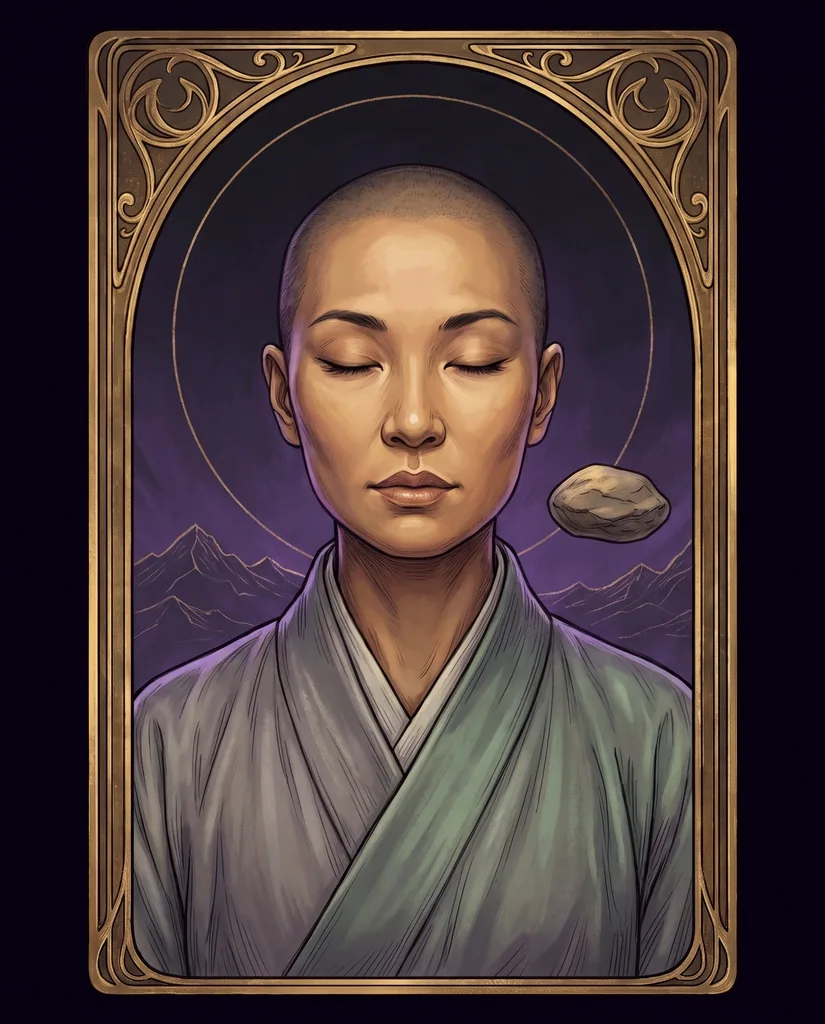
The Ascetic
Monk personality type
Masters the self first; the rest follows quietly.
These are the engine’s matching targets, not a score for any person — the Monk’s signature targets 90 on Focus.
You master yourself first, and let the rest follow quietly. Focus, discipline, and an uncommon steadiness let you hold a practice long past the point where most people drift — you're genuinely hard to rattle, and the noise that hijacks others tends to pass right through you. You keep your own counsel and your own routine, and you don't need a crowd or an audience to feel whole. The far edge of that composure is distance: you can turn so far inward that people struggle to reach you, guard your routines against any spontaneity, and let 'centered' slide quietly into 'unreachable.'
What is the Monk personality type?
The Monk is defined by the highest Focus, Conscientiousness, and Emotional Stability scores of any class, combined with very low Extraversion and very low Exploration — they master the self first and let everything else follow from that. This is a specific and rare alignment of sustained concentration, self-discipline, equanimity under pressure, and deliberate resistance to novelty or distraction.
Top strengths
- Exceptional self-control and steadiness under pressure
- Sustains deep focus and consistency for the long haul
- Calm, centered, and genuinely hard to rattle
Blind spots
- Can be too inward and detached from others
- Rigid routines; resists novelty and spontaneity
- Under-shares and can seem unreachable
Ideal environment
Stress trigger
Communication style
Party role
Subclasses
Concentration like a held breath.
Distraction barely lands — you turn all the way inward and the outside world goes quiet.
Does the hard thing, every day.
You run on iron routine; the hard thing gets done because it's simply what you do each day.
Needs solitude the way others need company.
You recharge alone and guard your independence closely.
Unmoved by the storm.
The storm doesn't move you because your attention doesn't — you stay on the one thing while the noise goes past.
Level-up quests
- Break one routine on purpose this week
- Let someone in on what you're actually feeling
- Try something with no mastery payoff, just for fun
Frequently asked questions
What are the Monk's strengths and blind spots?
Monks carry exceptional self-control and sustain deep focus and consistency over the long haul — the person who stays centered when everything else is on fire. The honest blind spot is that this inwardness can become detachment: Monks can be too removed from others, under-share what they're experiencing, and let rigid routines crowd out spontaneity in a way that costs them connection.
How rare is the Monk?
The Monk represents one of the more distinctive alignments in the quiz: three apex traits simultaneously — very high Focus, Conscientiousness, AND Emotional Stability — combined with low novelty-seeking. That specific combination of mastery-orientation and distraction-resistance is unusual in the reference population.
What's the difference between the Monk and the Oracle?
Oracles are curious and imagination-driven — they explore inward through ideas, pattern-seeking, and meaning. Monks are discipline-driven — they sharpen a consistent practice until it becomes second nature. Oracles score very high on Imagination/Openness; Monks score very low on Exploration and novelty. Oracles generate insight; Monks generate mastery.
Is the Monk based on real psychology?
The underlying traits — Focus, Discipline/Conscientiousness, and Emotional Stability/Resilience — are well-studied dimensions measured by public-domain IPIP Big Five items. The 'Monk' class is an original interpretive label for self-reflection and communication; it is not a clinical category, a spiritual tradition reference, or a deterministic character assignment.
Compare the Monk
The classes people most often weigh the Monk against — its closest signature neighbors, compared trait by trait with the engine’s real numbers.
Looking for the cultural idea of the monk rather than a trait pattern? That is a different idea with its own history — see the monastic vocation.
Keep exploring
This is a playful interpretation of a trait pattern, for self-reflection — not a clinical diagnosis or a claim that anyone “is” this class. Your real result depends on your own answers.