
Guide · Concepts
RPG archetypes vs. personality types
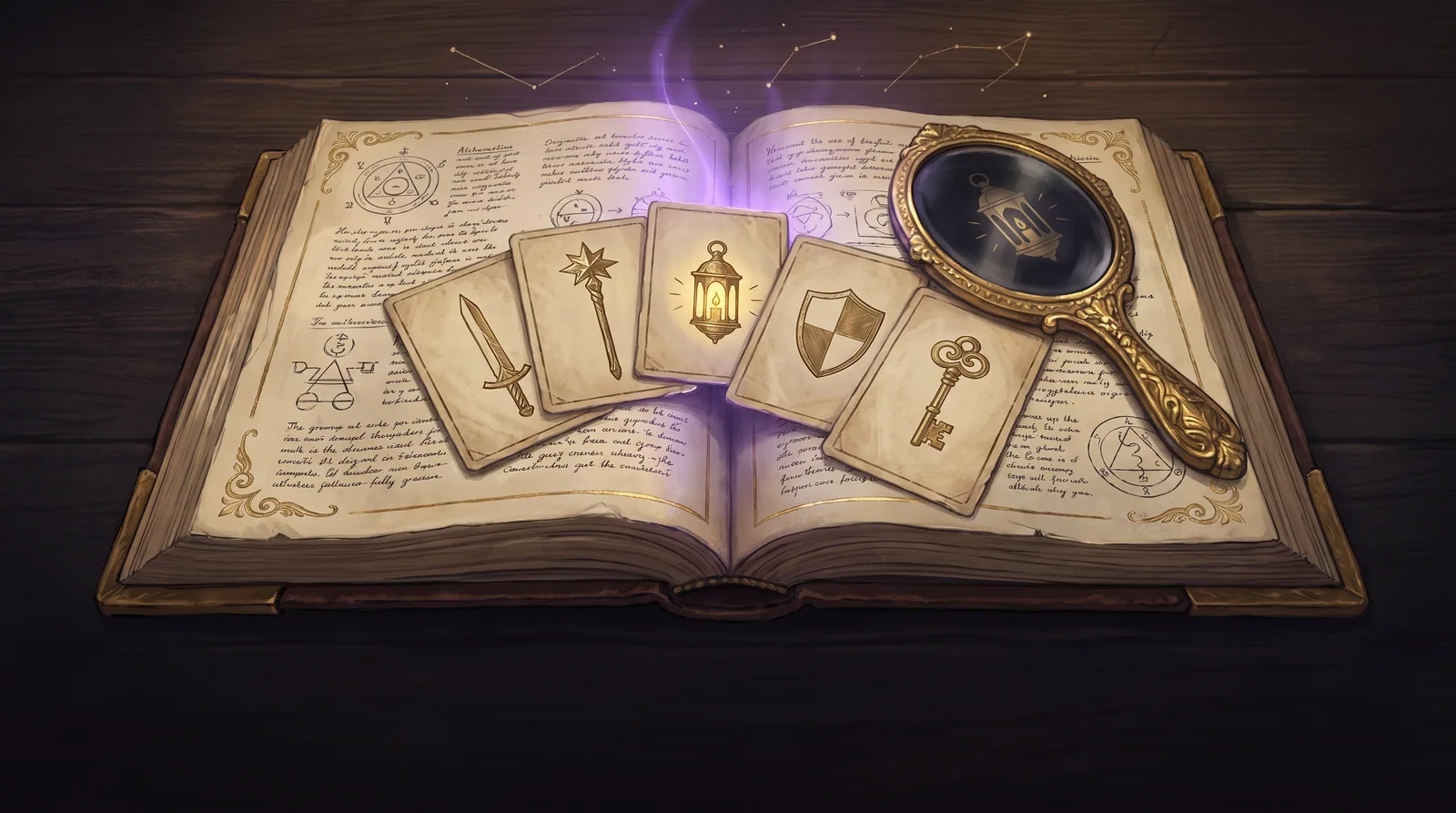
The Warrior, the Sage, the Trickster, the Caregiver — we recognise these instantly, and it’s tempting to treat “which one am I?” as the same question a personality test answers. It isn’t. An archetype is a role in a story; a personality type is a claim about who you are. The difference isn’t the shape — both are categories — it’s what each one is honestly allowed to promise.
Two different things wearing the same word
Call both of them a “type” and the confusion is baked in. A character archetype is a compressed story role: the moment you hear “the Mentor,” you know roughly how that figure moves through a plot. It’s a handle for a pattern of behaviour in a narrative — enormously useful for writing, casting, and, yes, building a game class you want to play.
A personality type points the other way. It doesn’t describe a role in a story; it makes a claim about you — that you belong, permanently, in one of a fixed set of boxes. The archetype says “here is a shape a character can take.” The type says “here is the shape you are.” That second sentence is doing a lot more work, and it needs a lot more evidence to earn.
Where archetypes actually come from
Not from a lab. Archetypes are old — myths recycled the same wise elder and cunning trickster for millennia. Jung borrowed the word for figures that recur across cultures; narrative theory later mapped the roles a hero, mentor, guardian, or shadow tends to play; and tabletop and video-game RPGs turned those roles into classes you could pick up and swing around (Jung, 1921). They feel true because they’re familiar — you’ve met a hundred versions of each — not because someone counted them in a population.
That origin is a feature, not a flaw, as long as you remember it. A story role is a mirror: you try one on, notice what fits and what chafes, and learn something. It stops being honest the moment it’s dressed in a lab coat and sold as a measurement of your fixed nature.
What each one is allowed to claim
Here’s the honest line. An archetype earns its keep as a handle and a mirror — a memorable way to talk about a pattern, prompt reflection, and share something about yourself. A personality type oversteps when it claims to be your diagnosis: fixed, exhaustive, and scientifically settled. The trouble is that the underlying traits it’s summarising are continuous — most people land somewhere in the middle — so any hard box drawn across them is a convenient fiction, not a natural kind. We pull that apart in types vs. traits.
So the failure mode isn’t “using an archetype.” It’s laundering an archetype into a certainty — “science says you’re a Strategist” — when the science only ever backed the trait numbers, and the archetype was the storytelling on top.
How Huesona uses archetypes honestly
We keep the seam visible. First the measurement: your answers become ten trait dimensions, each 0–100, shown as stat bars you can read directly — grounded in the public-domain Big Five (IPIP), and the part the research supports. Then, and only for the fun of it, we name the character class whose pattern your scores sit closest to. The class is an archetype in exactly the old sense: a story role you can try on, never a verdict on who you are.
And the story never eats the numbers. Every result shows your underlying scores, a plain-language “why” naming the traits that drove the match, and your runner-up class — so you can always see how close the call was and how much of you the single name leaves out. That’s the whole trick: take the archetype seriously as a mirror, and never let it pretend to be a measurement. The exact machinery is in how scoring works.
Common questions
What's the difference between a character archetype and a personality type?
An archetype is a story role — the Warrior, the Sage, the Trickster, the Caregiver — a familiar figure we recognise from myth, film, and games. A personality 'type' is a claim about who you are, sorting you into a fixed category. The honest gap is what each one admits to being: an archetype is openly a narrative handle, while a type system often borrows the authority of science to say the box is your permanent nature. Same shape (a category), very different promise.
Is an RPG personality quiz actually scientific?
It depends on what's underneath the fantasy. In Huesona, the trait dimensions are grounded in the public-domain Big Five (IPIP) — measured on continuous 0–100 scales — and that part is research-based. The character class laid on top is an openly playful interpretation of your pattern, not a scientific category. A quiz becomes dishonest only when it hides that seam and sells the archetype as a diagnosis. We label which part is measurement and which part is for fun, on every result.
Where do character archetypes come from?
From storytelling long before psychology. Jung used 'archetype' for recurring figures that show up across cultures and myths; narrative theory catalogued the roles a hero, mentor, or trickster plays; and tabletop and video-game RPGs turned those roles into playable classes. They resonate because they're familiar patterns of behaviour we've all seen, not because anyone measured them out of a population. That's exactly why they make a good mirror and a poor diagnosis.
References
- Jung, C. G. (1921). Psychological Types (Collected Works, Vol. 6). Princeton University Press. (Origin of the psychological “archetype” as a recurring narrative figure — a cultural pattern, not a measured category.)
- John, O. P., & Srivastava, S. (1999). The Big Five trait taxonomy: History, measurement, and theoretical perspectives. In L. A. Pervin & O. P. John (Eds.), Handbook of Personality: Theory and Research (2nd ed., pp. 102–138). Guilford Press.
- Soto, C. J., & John, O. P. (2017). The next Big Five Inventory (BFI-2). Journal of Personality and Social Psychology, 113(1), 117–143. doi:10.1037/pspp0000096
Last updated July 31, 2026.
A playful interpretation of your trait pattern, for self-reflection and communication. Not a clinical diagnosis, hiring assessment, medical tool, or therapy replacement.